Chiron in Taurus
The Great Exhaustion

A Lament
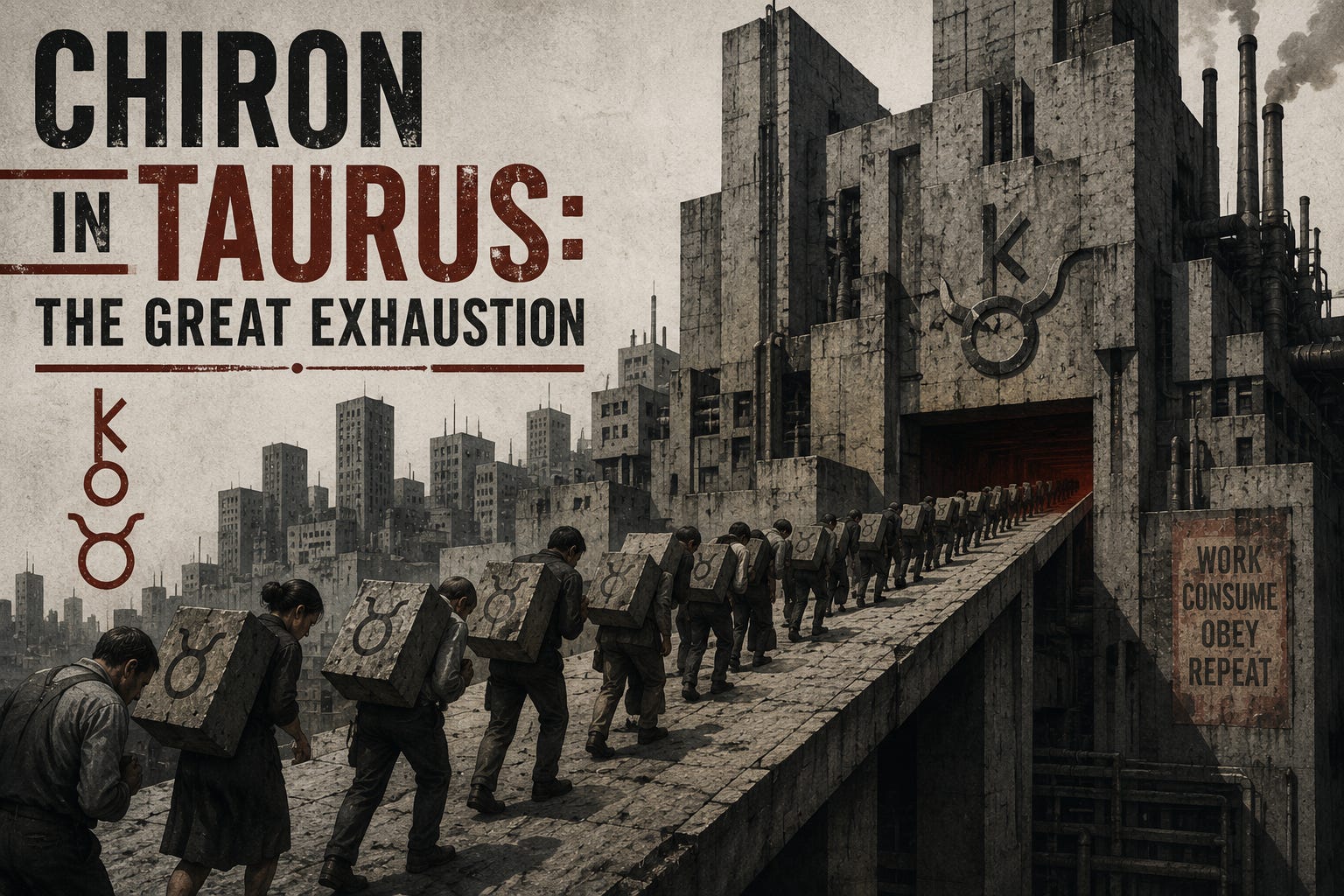
There are several threads running through this moment, and too often we tie ourselves into knots because we mistake one for another. Economics becomes politics. Politics becomes identity. Identity becomes morality. Before long, every conversation feels like an argument over which thread matters most, while the tapestry itself quietly unravels beneath our hands. To understand why so many people feel exhausted, we have to be willing to follow each strand separately before seeing where they converge.
The first thread is the simplest because it is the one most people feel in their bodies. Life has become harder to afford. Housing consumes more of a paycheck. Insurance climbs. Groceries cost more than they did a few years ago. Medical bills linger like ghosts. Families who once felt stable now budget with a quiet anxiety that rarely leaves them. Even those whose incomes have risen often discover that the increase disappears into the growing cost of simply maintaining yesterday’s standard of living. Whether one blames inflation, monetary policy, globalization, regulation, corporate concentration, or a dozen other forces, the lived experience is remarkably similar. More people are spending more energy just trying to stay where they already were.
The second thread is not economic at all. It is biological. Human beings are not built to live under permanent low-grade emergency. The nervous system can endure seasons of hardship when they are followed by recovery, but it begins to fray when vigilance becomes the baseline. Every unexpected expense feels like another predator in the tall grass. Every renewal notice carries a flicker of dread. Every trip to the mailbox or glance at a banking app asks the same silent question: “What now?” Over time, the body forgets what safety feels like. Exhaustion becomes a climate rather than a passing storm.
The third thread is cultural, and perhaps it cuts the deepest. In America, worth and work have become so tightly woven together that many people can no longer distinguish between them. We ask children what they want to be before we ask who they are. We celebrate productivity as though it were a virtue in itself. We quietly absorb the lesson that our contribution to the market determines our contribution to the world. Success becomes evidence of character. Struggle becomes something to explain away. Rest begins to feel suspicious.
This is where Chiron in Taurus speaks with unsettling clarity. Taurus is the ground beneath your feet. It is food on the table, a roof overhead, the certainty that tomorrow will resemble today closely enough that you can finally unclench your jaw. Chiron is the place where pain refuses to remain an event. It becomes a question that follows you everywhere. Together they ask what happens when survival itself becomes the wound. What happens when stability is no longer a place you reach but a horizon that keeps receding no matter how hard you walk?
The result is more than financial hardship. It is existential fatigue. You can work sixty hours a week and still wonder whether you are falling behind. You can do everything your parents told you to do and discover that the promises attached to those sacrifices no longer arrive. Somewhere along the way, the equation quietly changes. If security never comes despite all your effort, perhaps the problem must be you. The wound slips beneath the balance sheet and settles into the soul.
The fourth thread is political, and it is here that people often stop hearing one another. The explanations multiply. Some see corporate monopolies hollowing out communities in pursuit of quarterly profits. Others see governments captured by special interests, bureaucracies, or financial elites. Some point toward immigration, some toward globalization, some toward deregulation, some toward overregulation, some toward monetary expansion, and some toward decades of bipartisan decisions that slowly concentrated wealth and influence. These explanations compete fiercely, but beneath them lies a shared experience that deserves to be acknowledged before it is argued over. Millions of people feel as though the institutions that were meant to provide stability no longer see them except as numbers in a spreadsheet.
That feeling changes a society. It changes how neighbors speak to one another. It changes how families dream about the future. It changes the stories parents tell their children about what is possible. A people who no longer believe tomorrow will reward honest effort gradually stop investing emotionally in tomorrow at all. Cynicism becomes a form of self-defense. Anger becomes easier to carry than hope because hope requires vulnerability, and vulnerability feels expensive.
There is another cost that receives less attention because it cannot be measured in dollars. We sacrifice evenings with our children because overtime is available. We answer emails long after dinner because rent is due. We postpone friendships, postpone creativity, postpone love, postpone sleep, all in service to an economy that continually asks for one more hour, one more shift, one more compromise. The machine never announces that enough has been given. It simply presents another invoice.
People often say that everyone should hustle harder, adapt faster, reinvent themselves again. Sometimes that advice is practical. Sometimes reinvention is genuinely necessary. But there is something profoundly revealing about a civilization that answers collective exhaustion almost exclusively with individual obligation. If millions of people are running themselves ragged merely to remain in place, perhaps the only acceptable response is not another motivational slogan. Perhaps it is an honest question about whether the race itself has been designed well.
This is why Chiron in Taurus feels so strangely appropriate for this era. The wound is not merely poverty. It is not even inequality. The wound is the growing suspicion that your value has become inseparable from your economic utility. That your humanity has been quietly translated into a line item on someone else’s ledger. That the question “What are you worth?” has become impossible to distinguish from “What can you produce?”
Yet Chiron rarely leaves us where it finds us. Every wound eventually asks a question deeper than the pain itself. If your paycheck cannot define your worth, what can? If your profession disappears tomorrow, who remains? If markets fluctuate, institutions disappoint, and systems fail, is there something about a human being that exists prior to productivity and beyond consumption?
Perhaps that is the strange invitation hidden beneath this long season of strain. Not to romanticize hardship or excuse the forces that created it, but to refuse the lie that our value begins and ends with our usefulness. A civilization can forget that truth for a long time, but not forever. Eventually the wound becomes too obvious to ignore. Eventually enough people become tired enough to ask whether there is another way to measure a life.
We are not only living through an economic transition. We are living through a crisis of meaning disguised as a cost-of-living crisis. The bills are real. The exhaustion is real. The resentment is real. Beneath all of them, however, is an older and quieter question that has haunted civilizations whenever they drift too far into worshiping wealth above wisdom. What is a human being worth when the market stops applauding?
That may be the real wound of Chiron in Taurus. It is not simply that life has become more expensive. It is that millions of people are being forced to rediscover a value that should never have had a price attached to it in the first place.
I was born with Chiron in Taurus in my 11th House. I recognize this wound as something I've carried my whole life. It's an odd sort of homecoming to see that wound being reflected back in everything around me. Thanks for adding some clarity to that.
Thank you for those reflections. And perhaps this is also part of the reason he first showed himself to us when in the sign of Taurus. Humans, at least in the West, were already quite some way down that production/consumption path in the 70s, we just weren’t that aware of it yet. We now have the opportunity to re-take that lesson. And we know a lot better this time.