Mars in Gemini 2026
The Warrior Learns to Speak

The Warrior Learns to Speak
Part One: The Warrior Leaves Home
Mars Through Gemini
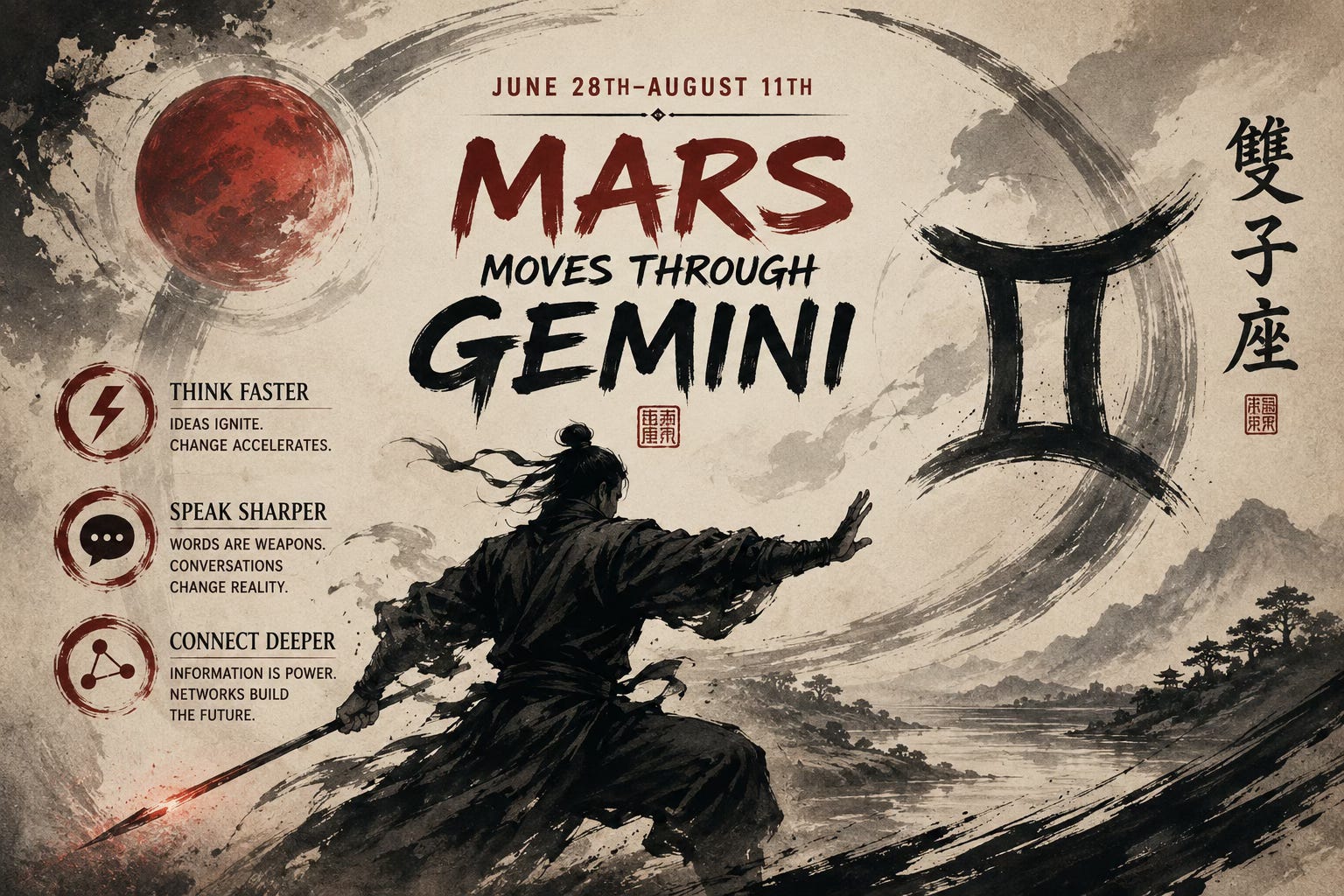
June 28th – August 11th, 2026
Every age imagines its ideal warrior differently.
Some celebrate the conqueror whose strength is measured in territory. Others honor the guardian who stands between a community and chaos. Some raise statues to kings. Others remember only the unnamed men and women who carried burdens no one else could carry. The image changes with the civilization because every civilization eventually discovers that it is fighting a different battle than the one its ancestors prepared for.
Our own moment is no exception.
We are living through an era in which information moves faster than institutions can absorb it, artificial intelligence is reshaping the nature of work and creativity almost monthly, and the stories that once held entire societies together are being questioned from every direction. Long-established authorities struggle to command trust while new voices emerge almost overnight. Every day brings another revelation, another reversal, another reminder that certainty has become one of the rarest commodities in public life. As the United States approaches its two hundred and fiftieth anniversary, the question feels less like a celebration than an invitation. What kind of republic do we believe ourselves to be? More importantly, what kind of people must we become to inhabit whatever comes next?
The astrology mirrors the atmosphere without dictating it.
Mars enters Gemini on June 28th, beginning a journey that lasts until August 11th. Mars is the ancient image of directed action. It is desire given legs, conviction given muscle, the willingness to leave safety behind in pursuit of something that matters. Mars is not inherently violent. It is simply the part of us that refuses permanent passivity. Every meaningful achievement, every difficult conversation, every act of courage begins with a Martian decision that remaining still is no longer acceptable.
Gemini speaks an entirely different language.
Gemini watches before it acts. It gathers fragments. It asks questions that other signs dismiss as distractions. It notices contradictions, shifting patterns, hidden connections, and alternative explanations. If Mars is the sword, Gemini is the hand turning the blade to examine how it was forged. Together they create an unusual figure: not the warrior who charges first, but the warrior who learns first. Victory no longer belongs to the strongest fighter. It belongs to the one who understands the terrain before everyone else realizes the battlefield has changed.
That distinction matters more now than it has in generations.
Many of us were taught to imagine conflict as something simple. Good versus evil. Truth versus lies. Left versus right. Nation versus nation. Those stories offer emotional clarity because they reduce complexity into teams. Yet the deeper one looks at history, economics, technology, or institutions, the harder those neat divisions become to sustain. Systems evolve. Incentives shift. Organizations begin serving purposes different from those that justified their creation. Individuals respond to pressures they did not design. History is rarely written by villains twirling mustaches. More often it is written by ordinary people navigating incentive structures that reward one behavior while quietly punishing another.
The coming weeks ask us to become students of those structures.
Mars in Gemini is not interested in winning arguments nearly as much as understanding how arguments arise in the first place. It asks why certain ideas spread while others disappear. Why some institutions adapt and others calcify. Why some civilizations renew themselves while others become prisoners of their own mythology. It teaches that perception is not merely observation. Perception is a strategic advantage. The person who understands how reality is changing often appears prophetic simply because they noticed what everyone else preferred to ignore.
In the oldest stories, every true journey begins with a departure from familiarity.
Our warrior leaves carrying the tools inherited from an earlier age. His sword is sharp. His training is sound. His confidence is genuine. He believes courage will be enough because courage has always been enough before. Somewhere beyond the horizon waits an enemy he imagines he already understands. He has been told that if he fights hard enough, speaks loudly enough, and refuses compromise, victory will eventually reveal itself.
He is wrong.
The road ahead does not lead toward a single enemy. It leads toward five teachers, each bearing a different face of wisdom. None of them will ask him to become weaker. Every one of them will ask him to become more difficult to deceive. Before the journey ends, they will transform how he sees the world, why he chooses to act within it, where power actually resides, what principles deserve his loyalty, and finally what all strength exists to protect.
The first teacher arrives as lightning.
Part Two: The Lightning
Mars Conjunct Uranus in Gemini
July 3, 2026
The warrior expected an ambush.
The maps had warned of enemy territory beyond the ridge. Old soldiers had spoken of fortified walls, disciplined ranks, and familiar tactics. Every lesson of his youth suggested that danger would announce itself in recognizable forms. He tightened his grip on his sword as he climbed the final rise, preparing himself for battle.
Instead, the mountain exploded.
The earth itself seemed to split apart as light tore across the sky. Roads vanished beneath his feet. Rivers abandoned their ancient courses. Towers that had stood for centuries crumbled into dust while forgotten paths emerged where no road had existed the day before. There was no army to defeat because the battlefield itself had become something new. The enemy was not another kingdom. It was the collapse of certainty.
For the first time since leaving home, the warrior understood that his greatest vulnerability was not weakness. It was confidence built upon assumptions that no longer matched reality. His training had prepared him to solve problems within an existing world. It had never imagined a world capable of rewriting itself while he was still walking through it.
So he did the only thing that still made sense.
He stopped trying to force reality back into the shape he expected. He began watching instead. He noticed that every collapse revealed another possibility. Every broken bridge exposed another crossing. Every failed prediction illuminated a hidden pattern that had always been there, invisible only because everyone had agreed not to look at it. The lightning was destructive, but it was also revelatory. It stripped away inherited expectations until perception itself became the only reliable compass.
Civilizations experience moments like this far less often than individuals, but they are unmistakable when they arrive.
The invention of the printing press did not simply improve books. It transformed authority. The telegraph altered politics by collapsing the time between events and their consequences. The internet dissolved geographic monopolies over information. Artificial intelligence now appears poised to do something equally profound, not because it possesses magic, but because it changes the economics of knowledge itself. Skills once considered uniquely human become widely available. Gatekeepers lose leverage. Entire professions begin renegotiating their purpose. Institutions built for one informational landscape suddenly find themselves governing another.
These moments are exhilarating and terrifying for exactly the same reason.
Old maps provide emotional security. They tell us where danger lives and where safety begins. They distinguish experts from amateurs, insiders from outsiders, truth from error. When the map fails, many people become more devoted to defending it than exploring the territory it no longer describes. They mistake loyalty to yesterday’s understanding for wisdom. Yet reality has never promised to preserve our comfort. It asks only whether we are willing to keep learning.
This is the strange genius of Mars meeting Uranus in Gemini.
Mars wants movement. Uranus introduces disruption. Gemini insists on curiosity. Together they create a warrior who survives not because he possesses the strongest armor, but because he abandons obsolete assumptions faster than everyone else. Adaptability becomes a form of courage. Intelligence becomes a martial virtue. Questions become sharper than swords.
The warrior gathers what remains of his equipment and looks back toward the valley he crossed only hours before.
Nothing has changed there except him.
He no longer mistakes certainty for strength. He has learned that the first casualty of transformation is often the story we were telling ourselves about the world. The lightning did not simply destroy his map. It changed the eyes that were reading it.
As the storm passes, another figure waits beside the road.
An old traveler, dressed more like a pilgrim than a soldier, watches the warrior approach with quiet amusement.
“You have learned that the world is larger than your assumptions,” the old man says.
“But tell me…”
“Do you know where you are actually going?”
Part Three: The Prophet
Mars Sextile Neptune in Aries
July 4, 2026
The old man carried no weapon.
His clothes were worn by years rather than battles, and his walking staff had been polished smooth by countless miles. He sat beneath the shade of an ancient tree overlooking a broad valley where villages, rivers, and distant cities shimmered beneath the afternoon sun. The warrior had expected another test of skill. Instead, the old man simply motioned for him to sit.
“You survived the storm,” he said. “Now tell me why you continue walking.”
The warrior answered quickly.
He spoke of duty, of justice, of protecting those he loved. He repeated the words he had learned as a child, the phrases that had carried him through training and given shape to his courage. They were good words, honorable words. Yet as he spoke them aloud, they sounded strangely borrowed, as though they belonged to someone else.
The old man smiled without judgment.
“There is nothing wrong with those answers,” he said quietly. “The trouble is that they are answers. I asked for your reason.”
Silence settled between them.
The warrior realized that he had spent years preparing to defend his convictions without ever asking where they had come from. He knew what banners he marched beneath. He knew the names of the enemies he had inherited. He knew the stories that had taught him who the heroes were supposed to be. Yet beneath all of that was a more difficult question. If every banner were lowered and every slogan forgotten, what destination would still call him forward?
The old man gestured toward the valley below.
“Every civilization,” he said, “lives inside a story. Some stories are wise enough to keep renewing themselves. Others become prisons built from memories. People imagine that nations are held together by laws or armies. Those matter. But before either of them comes imagination. A people must first agree upon who they are before they can decide what they will defend.”
The warrior looked toward the horizon where flags fluttered above distant settlements.
He had always imagined that myths belonged to the ancient world. Heroes, dragons, sacred kings, promised lands. Yet now he could see that modern societies were no different. They told stories about progress, freedom, markets, equality, destiny, security, innovation, identity. None of these stories were entirely false. None of them were complete either. Each illuminated part of reality while leaving other parts in shadow. The danger was never having a story. The danger was forgetting that it was one.
The timing of this meeting carried its own quiet symbolism.
As the calendar turned to the Fourth of July, millions would celebrate the birth of a republic founded upon extraordinary ideals. Liberty. Self-government. Equality before the law. Those principles remain among humanity’s greatest political achievements, not because they were ever perfectly realized, but because they provided a direction toward which generations could continually strive. A founding vision is less like a completed building than a compass. It offers orientation, not perfection.
Yet every nation eventually faces the same temptation.
To mistake its mythology for its reality.
When that happens, patriotism becomes nostalgia rather than stewardship. Citizens spend more energy defending inherited narratives than asking whether their institutions still serve the principles those narratives were meant to protect. The symbols remain while the meaning quietly migrates elsewhere. A civilization can continue repeating its founding words long after it has forgotten the questions that gave those words life.
The old man rose and began walking toward the edge of the ridge.
“Vision,” he said, “is not prediction. It is remembering what kind of future deserves your strength.”
Only then did the warrior understand why he had survived the lightning.
The storm had emptied his hands of certainty so they could carry something larger than certainty. Information alone could never tell him where to go. Intelligence without purpose eventually becomes cleverness in search of a master. The mind could identify a thousand possible roads, but only vision could choose one. Adaptation had taught him how to see the changing world. Meaning would decide which part of that world was worth building.
The old man pointed toward a distant mountain.
Its summit disappeared into clouds, but beneath its slopes the warrior could make out immense stone gates carved into the earth itself.
“There,” the prophet said.
“If you wish to understand why kingdoms rise and fall, stop looking at their monuments.”
“Go beneath them.”
The warrior bowed his head, thanked the old man for his counsel, and continued alone toward the mountain, carrying a new burden that somehow felt lighter than the armor he had worn before.
For the first time, he was no longer asking only what he should fight.
He was asking what future his victories were meant to make possible.
Part Four: The King Beneath the Mountain
Mars Trine Pluto in Aquarius
July 5, 2026
The entrance to the mountain was not guarded by soldiers.
There were no banners, no walls, no declarations of sovereignty carved into the stone. A narrow passage disappeared into darkness, almost deliberately easy to overlook. The warrior hesitated. Every instinct told him that something this important should announce itself. Instead, the place where kingdoms were truly governed looked almost abandoned.
As he descended, the air grew warmer.
The tunnel opened into an immense chamber filled not with treasure, but with movement. Messengers carried sealed documents between unseen offices. Engineers adjusted gears larger than houses. Scribes recorded decisions whose consequences would not be visible for years. Traders negotiated shipments of grain. Mathematicians calculated taxes. Inventors demonstrated impossible machines. Everywhere the warrior looked, thousands of ordinary people were making ordinary decisions that, together, quietly determined the fate of the realm above.
There was no throne.
Only then did he understand why the prophet had sent him here.
Power was not a man.
Power was a system.
A voice echoed through the chamber before its owner emerged from the shadows.
“You expected a king.”
An old figure stepped into the light, dressed plainly enough to be mistaken for another craftsman. There was no crown upon his head, yet everyone around him subtly adjusted their work as he passed, not because they feared him, but because they understood the architecture he represented. He governed less by command than by comprehension.
“The world above,” the old man said, “believes history is made by speeches, elections, battles, and great personalities. Those things matter. They are the visible surface. But every visible event rests upon an invisible structure of incentives. Change the incentives, and eventually the speeches change. The leaders change. Even the beliefs begin to change.”
The warrior thought of every conflict he had ever studied.
He remembered the stories of heroes and tyrants, revolutions and betrayals. Yet standing beneath the mountain, those stories began to feel incomplete. Wars were supplied by economies. Economies rested upon energy, trade, and technology. Institutions protected themselves according to their incentives. Newspapers competed for attention. Political movements sought donors, volunteers, and legitimacy. Even families developed habits that rewarded some behaviors while quietly discouraging others. Every individual possessed agency, but that agency always unfolded inside a larger architecture.
The old man walked toward a great machine whose gears turned with almost silent precision.
“This,” he said, “is why conspiracy thinking is so seductive.”
The warrior looked puzzled.
“It offers the comfort of a single hidden hand.”
The old man rested his palm upon the machine.
“But reality is usually more demanding than that. Institutions become ecosystems. Networks emerge that no single person controls. Individuals pursue status, security, profit, influence, belonging, or survival. Each believes they are acting rationally. Together they create outcomes that none of them fully intended. People search endlessly for puppet masters because they find systems emotionally unsatisfying. Systems have no face to hate.”
The warrior watched as one small adjustment rippled through the machinery.
A merchant altered the price of grain. Farmers planted different crops. Trade routes shifted. Villages prospered while others declined. Politicians responded to changing conditions. Laws were rewritten. A generation later, historians would describe the transformation as though it had begun with a charismatic leader, never realizing that the machinery beneath the mountain had already changed direction decades before anyone gave the movement a name.
He began thinking about his own age.
Artificial intelligence was not merely another invention. It was altering incentives around knowledge itself. Information networks rewarded speed more readily than wisdom. Institutions built for industrial societies struggled to adapt to exponential technological change. Trust became fragmented across thousands of competing realities. Every new communication technology redistributed influence before anyone fully understood its consequences. Public arguments often focused on personalities while the deeper transformation occurred quietly within the structures that determined what information spread, what behaviors were rewarded, and what futures became economically possible.
The king noticed the warrior’s expression and nodded.
“Now you are beginning to see.”
“Most people ask, ‘Who is in charge?’”
He smiled gently.
“The better question is, ‘What system makes this behavior logical?’”
The chamber suddenly looked different.
The warrior no longer saw corruption where he had once seen only corruption, nor virtue where he had once seen only virtue. He saw incentives. He saw feedback loops. He saw institutions adapting to preserve themselves. He saw genuine idealists constrained by structures they did not create and opportunists exploiting structures they barely understood. None of this removed moral responsibility. If anything, it increased it. One could no longer excuse oneself by blaming invisible villains. To change history required changing the architecture that made history predictable.
The old king led him back toward the stairs.
“You arrived believing power belonged to those who held the sword.”
He looked toward the bustling chamber one last time.
“Then you believed power belonged to those who wrote the story.”
His eyes met the warrior’s.
“Now you understand that both swords and stories are downstream from structure.”
The warrior climbed back toward the daylight carrying no new weapon.
Instead, he carried a different way of seeing.
The lightning had taught him that reality changes.
The prophet had taught him that vision gives change its direction.
The king beneath the mountain had taught him that if he wished to change the world, he would first have to understand the invisible architecture from which the visible world continually emerged.
When he reached the summit, another figure was waiting.
An old guardian stood beside a weathered stone marked with ancient vows.
He did not ask what the warrior had learned.
He asked what the warrior was willing to promise.
Part Five: The Oath Stone
Mars Sextile Saturn in Aries
July 19, 2026
The guardian stood alone.
He was neither young nor old, neither imposing nor frail. Time seemed to have settled into him rather than passed over him. Beside him rested a single stone worn smooth by generations of hands, its surface carved with names that had faded long before the kingdoms that once spoke them. There were no laws etched into the rock, no commandments, no promises of reward.
Only names.
The warrior approached with the confidence of someone who had survived every trial placed before him. The lightning had taught him to abandon certainty. The prophet had given him a vision worth pursuing. The king beneath the mountain had shown him the hidden architecture of power. Surely this old sentinel had one final lesson before the journey’s end.
Instead, the guardian asked a single question.
“What have you chosen that will still be true when circumstances stop rewarding it?”
The warrior opened his mouth to answer, then stopped.
Until that moment, he had imagined character as something a person possessed. Courage. Honor. Integrity. Discipline. They were qualities one either had or lacked. But standing before the stone, another possibility emerged. Perhaps character was not a possession at all. Perhaps it was the accumulation of promises kept when breaking them would have been easier.
The guardian rested his hand upon the weathered surface.
“Every civilization praises freedom,” he said. “Far fewer understand what preserves it.”
He traced one of the ancient names with his finger.
“Freedom is not sustained by desire alone. Desire changes with the weather. It rises with abundance and retreats before hardship. A people remain free because enough individuals voluntarily bind themselves to principles that cannot be renegotiated every time they become inconvenient.”
The warrior thought of the machinery beneath the mountain.
He understood now that institutions reflected incentives. Networks followed patterns. History emerged from countless ordinary decisions. Yet systems alone could not explain everything. Every structure, no matter how sophisticated, eventually rested upon the willingness of real people to keep faith with obligations that no law could fully enforce. Trust. Duty. Restraint. Responsibility. These invisible commitments were themselves a kind of infrastructure. Once they weakened, the machinery began to grind against itself.
This was Saturn’s quiet wisdom.
There is a temptation in every revolutionary age to believe that liberation means escaping all limits. New technologies promise limitless possibility. Old authorities lose their legitimacy. Information flows around every barrier. The future appears infinitely malleable. Yet history suggests something more paradoxical. The societies that endure are rarely those that reject discipline. They are those that consciously choose which disciplines remain worthy of preservation while allowing everything else to evolve.
As the United States approached its two hundred and fiftieth year, this question felt increasingly difficult to avoid.
What, exactly, deserved to endure?
Not every institution should be preserved simply because it is old. Not every tradition deserves loyalty because it is familiar. Neither should every inheritance be discarded because it originated in another age. Renewal requires discernment rather than reflex. It asks whether a principle still serves the human beings it was meant to protect. Liberty without responsibility becomes license. Authority without accountability becomes domination. The work is not choosing freedom or order. The work is remembering that each depends upon the other.
The guardian picked up a small chisel and placed it beside the stone.
“No one writes your oath for you.”
The warrior understood.
Every teacher until now had changed the way he perceived reality. This teacher required something more dangerous. Choice. No insight, however profound, could substitute for commitment. Wisdom remained only potential until it shaped behavior. The warrior could spend the rest of his life studying systems, questioning narratives, and adapting to change. None of it would matter if he never decided what he would refuse to betray.
He took the chisel.
For a long time, he did not carve a word.
He thought about the people he hoped to serve rather than impress. He thought about truth spoken without cruelty, strength exercised without vanity, conviction held without fanaticism. He thought about the temptation to become cynical after seeing how institutions actually functioned, and the equal temptation to become naive by pretending they did not. Somewhere between those extremes lived integrity.
Finally, he carved a single line.
Not a promise to win.
Not a promise to be right.
A promise to remain in service to what was true, even when the truth demanded that he change.
The guardian nodded once.
“Now,” he said quietly, “you are no longer being carried by your convictions.”
“You are carrying them.”
As the warrior stepped beyond the Oath Stone, he felt strangely lighter than he had at the beginning of the journey. He had left home believing strength meant imposing his will upon the world. Each teacher had removed another layer of that illusion. Now he walked not because certainty compelled him, nor because ideology demanded it, but because he had willingly accepted the burden of becoming the sort of person capable of carrying power without being consumed by it.
Ahead, beyond a low wall of flowering hedges, he caught his first glimpse of a place unlike any he had yet encountered.
There were no fortifications.
No towers.
No armies.
Only a garden waiting in perfect silence.
Part Six: The Garden
Mars Square Venus in Virgo
July 29, 2026
The warrior entered expecting another lesson.
Instead, he found people tending flowers.
Children carried water from a spring that had flowed for centuries. An old woman pruned fruit trees whose branches bent beneath their own abundance. A mason repaired a cracked wall so carefully that the new stones disappeared into the old. Two musicians argued cheerfully over a melody while a pair of young lovers laughed at neither of them. Everywhere there was work, but none of it carried the urgency of survival. It possessed another quality entirely. Care.
The warrior felt strangely out of place.
His armor bore the scratches of long travel. His boots carried the dust of ruined roads. His mind still echoed with the thunder of the mountain and the machinery beneath it. He had spent weeks learning how the world actually functioned, peeling away comforting illusions one by one. Standing in the quiet of the garden, he wondered whether any of those hard-earned truths belonged here at all.
The keeper of the garden greeted him with a smile that revealed nothing.
She did not ask where he had traveled.
She did not ask what he had learned.
She did not ask how many battles he had won.
Instead, she handed him a small basket and pointed toward a row of herbs whose leaves had begun to yellow.
“Help me.”
The warrior almost laughed.
He had crossed storms, descended into kingdoms beneath mountains, and sworn an oath before ancient stone. Now he was being asked to pull weeds.
He knelt anyway.
As the morning passed, something unexpected happened. The work demanded exactly the same attention the prophet had asked of him, the same adaptability the lightning had awakened, the same understanding of systems the king had revealed, and the same discipline required by the oath stone. Every plant depended upon the others. Water given carelessly drowned one root while leaving another thirsty. A neglected path slowly disappeared beneath growth. Beauty was not spontaneous. It was maintained through thousands of ordinary acts performed faithfully over time.
The keeper watched him work before finally speaking.
“Most people think civilization is built by those who win wars.”
She gently brushed soil from a blossom.
“Civilization is built by those who plant orchards whose fruit they will never eat.”
The warrior looked around the garden again.
He realized that every previous teacher had shown him how to acquire power without ever explaining its purpose. Adaptation allowed societies to survive. Vision gave them direction. Understanding systems made effective action possible. Discipline gave that action endurance. But none of those gifts explained why survival mattered in the first place. A civilization does not exist simply to continue existing. It exists so that beauty, learning, friendship, family, craftsmanship, music, worship, laughter, and love may have a place to flourish.
This was the lesson he had not known he was missing.
Power is always tempted to justify itself.
Governments begin believing their own preservation is the highest good. Corporations mistake perpetual growth for purpose. Movements forget the people they originally hoped to serve. Even individuals can become so consumed with winning arguments, accumulating influence, or exposing hidden structures that they gradually lose contact with the ordinary human experiences that made those pursuits worthwhile. Means quietly replace ends. The machinery beneath the mountain begins running for its own sake.
The keeper led him to the center of the garden where a single rose grew from a weathered stone wall.
“It would be easy,” she said, “to defend this garden by building higher walls.”
She paused.
“But eventually there would be nothing left inside worth protecting.”
The warrior understood immediately.
Every teacher had transformed him because every teacher had taken something away. The lightning had taken certainty. The prophet had taken borrowed purpose. The king had taken simplistic ideas of power. The guardian had taken the illusion that principles required no sacrifice. Now the garden asked him to surrender the last temptation of the warrior: believing that conflict itself gives life meaning.
Conflict is never the destination.
It is, at best, the difficult work required to preserve the conditions under which something gentler can survive.
As the sun began to set, the keeper handed him a single seed.
“Take this home.”
The warrior turned it over in his hand.
“So small?”
She smiled.
“Every forest begins this way.”
Only then did he understand why no treasure had awaited him at the end of the journey.
Treasure belongs to stories about wealth.
Seeds belong to stories about responsibility.
He looked back across the path he had traveled.
The man who had left home would have searched the horizon for another battle.
The one who now stood in the garden found himself wondering instead what could be planted, restored, repaired, taught, protected, and passed on. Strength had not become less important. It had become subordinate to something greater. The sword was still necessary, but only because gardens exist.
When he finally turned toward the road leading home, the journey itself seemed to bow its head in quiet recognition.
The warrior had not become invincible.
He had become useful.
Coda: Returning Home
Mars Enters Cancer
August 11, 2026
When the warrior finally reached the village, almost nothing had changed.
The same fields stretched toward the horizon. Children still chased one another through the square. The blacksmith’s hammer echoed across the afternoon as it always had. Smoke drifted from familiar chimneys. The people who greeted him saw only that he had returned from a long journey. They searched his face for stories of distant kingdoms and impossible battles, expecting trophies, scars, or songs worthy of retelling.
Instead, he carried a single seed.
Some wondered whether he had failed.
Where was the captured banner? Where were the riches won from defeated kings? Where were the secrets powerful enough to transform the village overnight? People often imagine wisdom should arrive dramatically, announcing itself with certainty and demanding immediate recognition. Yet the deepest transformations rarely resemble triumph. They reveal themselves quietly, in the way a person now listens before speaking, asks before accusing, builds before destroying, and notices patterns that once remained invisible.
The warrior understood something that could not easily be explained.
He had left believing that strength meant imposing himself upon the world. The lightning had taught him that reality refuses to remain still for anyone’s convenience. The prophet had taught him that action without vision eventually becomes wandering. The king beneath the mountain had shown him that history is shaped less by personalities than by the architectures that reward particular behaviors. The guardian had taught him that principles become real only when they survive inconvenience. The keeper of the garden had answered the question every warrior must eventually face: what, exactly, is all this strength for?
The answer was never victory.
Victory is temporary.
Every generation wins battles that the next generation barely remembers. Every empire reaches a summit before beginning its descent. Every institution eventually outlives some of the assumptions that created it. Even revolutions grow old. History has no permanent winners because history itself never stops moving. The purpose of strength cannot be found in accomplishments that time inevitably erodes.
It must be found in stewardship.
As Mars leaves Gemini and enters Cancer, the symbolism feels almost inevitable. The warrior who departed seeking conquest returns seeking home. Cancer reminds us that every outward journey ultimately circles back to questions of belonging, family, memory, inheritance, and care. It asks what kind of shelter we are creating for those who come after us. It shifts the center of gravity from proving ourselves to protecting what allows life to continue with dignity.
There is something profoundly appropriate about this transition occurring during America’s two hundred and fiftieth year.
Anniversaries invite celebration, but they also invite examination. A republic is not preserved by reciting its founding documents any more than a family is sustained by framing old photographs. Living traditions require continual renewal. Each generation inherits institutions it did not build, technologies it did not invent, debts it did not incur, and opportunities it did not create. The question is never whether we inherit imperfectly. The question is whether we become wiser stewards than our predecessors managed to be.
That responsibility feels particularly urgent in an age shaped by artificial intelligence, accelerating technological change, and increasingly fragmented realities.
We are learning that information alone cannot save a civilization. Intelligence without wisdom becomes optimization in search of a purpose. Technology amplifies whatever values already guide the hands that wield it. If our incentives reward spectacle over substance, machines will produce more spectacle. If they reward truth, craftsmanship, curiosity, and service, they will amplify those instead. The future will not simply be invented. It will be cultivated.
The warrior planted the seed beside his home.
Not because he expected to sit beneath its shade.
Because someone eventually would.
That is the final paradox of Mars in Gemini. The journey begins with a warrior seeking better weapons and ends with a citizen becoming a better ancestor. Knowledge was never the destination. Adaptability was never the destination. Even power was never the destination. Each was only another tool in service to something quieter and infinitely more enduring.
The greatest warriors are not remembered because they defeated every enemy.
They are remembered because, after the battles ended, they knew what was worth rebuilding.
Perhaps that is the real invitation of this season.
To become difficult to deceive.
To become worthy of trust.
To understand power deeply enough that we no longer worship it.
To cultivate wisdom patiently enough that others may someday inherit its fruit.
The warrior came home carrying no treasure.
He carried something far more dangerous.
He had learned what strength was actually for.
Thank You! ❤️ The Story Format! It makes the complex material a lot more digestible. I will be reading this post the entire week. 🐦⬛❤️ spot on as usual!